
Chinese Foreign Minister Wang Yi said that it is imperative for the two sides to view each other as partners and opportunities rather than rivals or threats, and invest their valuable resources in development and revitalisation.
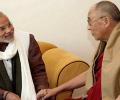
China has protested to India over Prime Minister Narendra Modi's greetings to the Dalai Lama on his 90th birthday and the attendance of Indian officials at the celebrations, stressing New Delhi should appreciate Beijing's sensitivities on Tibet-related issues.
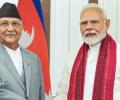
Nepal's claim on Lipulekh and Kalapani reopens a 200-year-old border dispute, while historical maps and treaties show the area belongs to India, asserts Lieutenant General Shakti Gurung (retd).

One priority for Delhi (for the new foreign secretary in particular) is to have an in-depth discussion with Dharamsala as soon as possible, suggests Claude Arpi.

This development comes against the backdrop of Beijing announcing Chinese names for some places in Arunachal Pradesh, which the neighbouring country claims as the southern part of Tibet.

'We are now in a situation where our country is not yet free.' 'China is still very strong and militarily powerful.' 'In such a situation, we need the Dalai Lama to bring about a resolution to the cause of Tibet.' 'That's one of the main reasons that at age 90, he has accepted that there should be a 15th Dalai Lama after him.'

In a statement, the BJP MP of Aarunachal East constituency said communities living beyond the McMahon Line share "deep civilisational roots with Bharat", and it's time for India to reclaim the regions "that are rightfully part of our country".
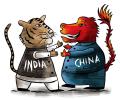
India and China have announced a series of measures aimed at improving their relationship, including maintaining peace along the border, reopening border trade, and resuming direct flights.

There are certain exotic species of wildlife that can only be viewed in their natural habitat in India.
There are certain exotic species of wildlife that can only be viewed in their natural habitat in India.

His successor issue is also expected to flare up fresh tensions between Beijing and Washington as China's policy comes in conflict with the US Tibetan Policy and Support Act of 2020, which reaffirmed America's steadfast support for the Dalai Lama and Tibetan Buddhism.

Amid unrest in Nepal, pilgrims from Tamil Nadu crossed the border for Kailash Mansarovar, and a wedding was held at the India-Nepal border.

On July 2 or July 6, the Dalai Lama will reveal his mind on his successor. This makes Beijing extremely nervous as the Communist regime fully realises the importance of controlling the next Dalai Lama, points out Claude Arpi.

One can only sincerely wish the Dalai Lama a very long life at the service of world peace. His presence is much required today on the planet, notes Claude Arpi, who has known His Holiness for more than half a century.
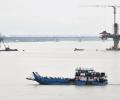
'China could intentionally release excess water.' 'The North East is already flood-prone during the monsoon, and even a controlled release from Chinese dams (during the monsoon) could worsen flooding.'
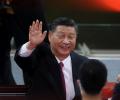
Xi's visit to Nyingchi, bordering Arunachal Pradesh, signals China's opening of another front to India in the eastern sector, observes Srikanth Kondapalli, the leading China expert.

Chhonzin Angmo became the first visually-impaired woman from India to plant the Tricolour on Earth's highest mountain.
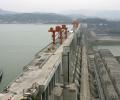
China defends its construction of a dam on the Brahmaputra river in Tibet, addressing concerns from India and Bangladesh about its potential impact on water flow and the environment.

The administration appealed that the process of law should be allowed to take its own course and expressed confidence that "together we will bring back normalcy in the peace-loving Leh township and continue with our dialogue process".

Lieutenant General Shakti Gurung deserves to be complimented in telling his life story and that of his people, as subaltern communities within this vast and diverse nation of ours clamour for recognition and a plea for their voices to be heard and their aspirations to be met, notes Lieutenant General Gautam Moorthy.
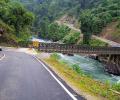
India on Wednesday outright rejected China's attempts to rename some places in Arunachal Pradesh, saying such 'preposterous' attempts will not alter the 'undeniable' reality that the state 'was, is, and will' always remain an integral part of India.

Why can't the Indian government propose to the Chinese a corridor circumambulating the Holy Mountain where people from both sides could perform the yatra again? asks Claude Arpi.

Sonam Wangchuk is under tight surveillance within the three-tiered prison, with CCTV cameras monitored around the clock.

Defence Minister Rajnath Singh has conveyed to his Chinese counterpart Admiral Dong Jun that India and China should maintain the positive momentum in the bilateral ties and avoid adding new complexities.

Many people believe that India's first prime minister Jawaharlal Nehru made a blunder when he recognised China's sovereignty over Tibet but he did what he thought was best for his country, said the president of the Tibetan government in exile.
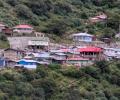
At the end of the discussion, the older Monpa said that if today the Chinese were to come inside India, "I will fight and kill them", prudently adding, "if they are of my age, if they are younger soldiers, I will not be able to fight". The entire village had a good laugh.

'China has thus far been cautious, emphasising its focus on development rather than weaponising water resources.'

For India, Tibet is just one of the topics they may or may not raise during the ongoing visit of Chinese Premier Wen Jiabao. But for the fraction of Tibetans in exile settled in India, the talk regarding the status of Tibet is of paramount importance.

China displayed a range of new weapons at a military parade, including laser weapons, nuclear ballistic missiles, giant underwater drones, and fifth-generation aircraft.

The MiG-21's sharp silhouette and supersonic roar will live on in the memories of those who flew it, those who maintained it, and those who watched it streak across the sky as a symbol of India's strength, asserts IAF veteran Air Commodore Nitin Sathe (retd).
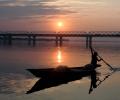
China has reiterated its plan to build the world's largest dam over the Brahmaputra River in Tibet, near the Indian border. The Chinese Foreign Ministry has assured that the project, estimated to cost around USD 137 billion, will not have any negative impact on downstream countries, India and Bangladesh. The ministry has stated that the project has undergone rigorous scientific verification and will be conducive to disaster prevention and mitigation, as well as climate change response. India has expressed concerns about the dam, raising the issue during talks with the visiting US National Security Advisor, Jake Sullivan. China has maintained that the project will not negatively affect the lower reaches and has committed to maintaining communication with downstream countries.
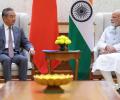
'New Delhi is not naive about its foreign policy choices.'

A total of 750 pilgrims have been selected through a computerised draw for the upcoming Kailash Manasarovar Yatra in Tibet, marking the resumption of the pilgrimage after a five-year gap. The Yatra's resumption is seen as an attempt to normalize India-China relations, which were strained by the eastern Ladakh border standoff. The pilgrimage will begin in June and continue until August, with pilgrims traveling in five batches via the Lipulekh route and ten batches via the Nathu La route. The selection process was deemed "fair, computer-generated, random, gender-balanced" by the Ministry of External Affairs (MEA), which organized the pilgrimage.
The Dalai Lama, in a message, said that since India was Tibet's southern neighbour and since a relationship between the countries had existed for centuries, he held concern from this nation for the Tibet issue was of utmost importance.
India has expressed concerns over China's plan to build a mega dam on the Brahmaputra River in Tibet, stating that it will continue to monitor and take necessary measures to protect its interests. New Delhi has urged Beijing to ensure that the interests of downstream states are not harmed by activities in upstream areas. The dam, estimated to cost USD 137 billion, has raised apprehensions about its impact on the ecological balance of Arunachal Pradesh and Assam, through which the Brahmaputra flows. India has repeatedly expressed its concerns to China through diplomatic channels, highlighting the need for transparency and consultation with downstream countries.

India is preparing to resume the Kailash Mansarovar Yatra, a pilgrimage to Mount Kailash in Tibet, after a three-year hiatus. The decision comes as part of efforts to improve relations between India and China, which have been strained since a military standoff in 2020. The two countries have also agreed in principle to resume flight services between them.

A heavy rain Sunday morning did little to dispirit the thousands who gathered in the main courtyard of Tsuglagkhang, the Dalai Lama temple, to observe the 90th birth anniversary of the 14th Dalai Lama.
China has approved the construction of the world's largest dam on the Brahmaputra River in Tibet, close to the Indian border. The USD 137 billion project, which is expected to dwarf even China's own Three Gorges Dam, has raised concerns in India and Bangladesh, the downstream riparian states. Concerns in India are centered around China's potential to control water flow, potentially enabling the release of large amounts of water to flood border areas in times of hostilities. The dam is part of China's 14th Five-Year Plan, and the Chinese government claims that the project is safe and prioritizes ecological protection.
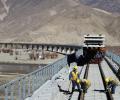
Arunachal Pradesh Chief Minister Pema Khandu has expressed grave concerns over China's mega dam project near the Arunachal border, calling it a 'water bomb' and an existential threat.

India's External Affairs Minister S Jaishankar has stated that the US administration under President Donald Trump is moving towards multipolarity, which aligns with India's interests. He also revealed that India and the US have reached an agreement on the need for a bilateral trade pact. Jaishankar touched upon various foreign policy issues including India's role in the Russia-Ukraine conflict, the trajectory of the BRICS grouping, and relations with China during a session at the Chatham House think-tank in London.
